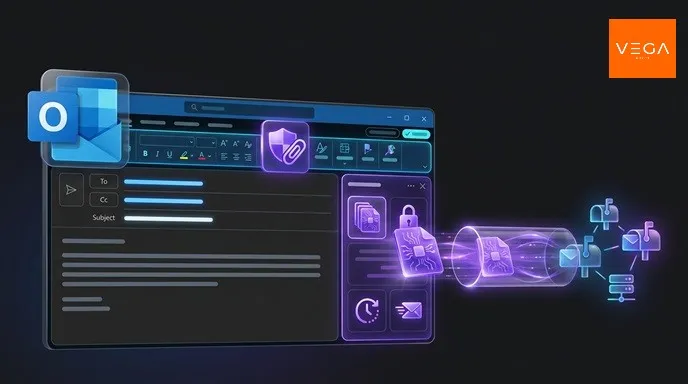
In today’s digital landscape, email remains the default backbone of everyday corporate communication. However, when it comes to transmitting confidential documents, financial credentials, or private intellectual property, traditional email is fundamentally broken.
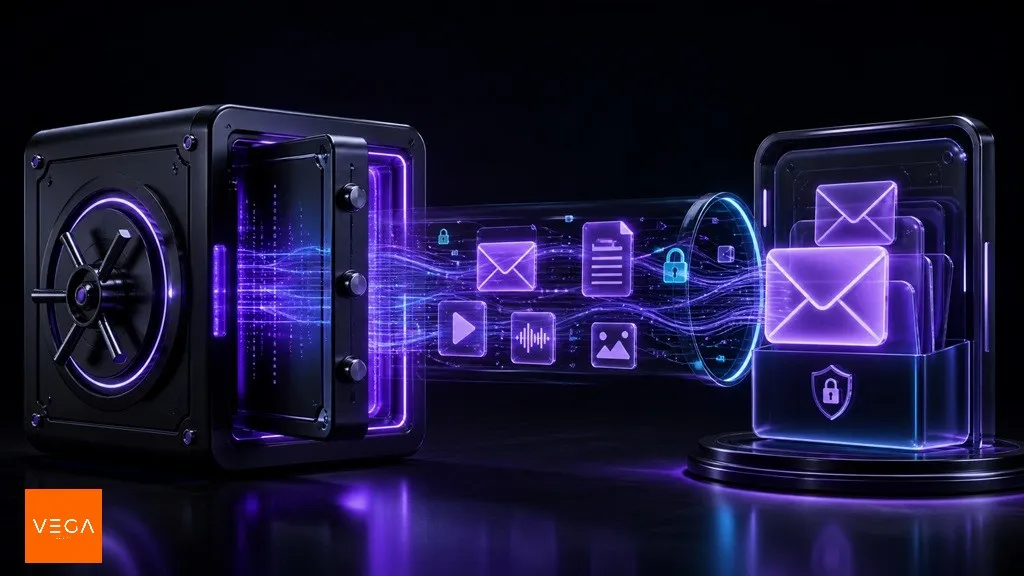
Standard email was designed in the 1970s for open delivery, not confidential security. Messages travel through multiple relays in plaintext, leave permanent server backups, and cannot be revoked once sent. Modern zero-knowledge sharing replaces open attachments with ephemeral, client-side encrypted payloads.
The 10 Critical Flaws of Standard Email
1. Lack of True End-to-End Encryption
Most popular email providers only protect emails in transit using Transport Layer Security (TLS). Once a message arrives at the destination mail server, it sits as unencrypted plaintext on cloud disk storage — exposed to server intrusions, cloud provider administrators, and regulatory subpoenas.
2. Indestructible Digital Paper Trails
Unlike ephemeral messaging, standard emails linger indefinitely across:
- Mail server backup snapshots.
- Recipient inbox archives and forwarded threads.
- Third-party indexing and discovery tools.
3. Primary Vector for Phishing & BEC Fraud
Email headers can be easily spoofed. Business Email Compromise (BEC) and sophisticated spear-phishing campaigns exploit human trust, tricking employees into exposing trade secrets.
4. Zero Access Control or Revocation
Once you hit “Send”, you surrender complete control over your file:
- Anyone can forward your contract or spreadsheet to unintended parties.
- You cannot revoke access or set self-destruct timers.
- You have zero visibility into who opened or downloaded the payload.
5. Regulatory Non-Compliance & Severe Penalties
Transmitting unprotected personal or financial data over open email violates major compliance standards including GDPR, HIPAA, SOX, and PCI-DSS — leading to substantial regulatory fines.
6. Centralized Server Vulnerabilities
Enterprise mail servers are high-value targets for advanced threat actors. High-profile breaches at major email and cloud providers demonstrate that centralized storage is inherently risky.
7. Weak Authentication Primitives
Standard email accounts frequently rely on basic passwords or SMS 2FA, making them vulnerable to credential stuffing, SIM swaps, and session token theft.
8. Cross-Border Data Routing & Sovereignty
When you send an email, network routing algorithms bounce packets across intermediate routers located in multiple countries — subjecting your sensitive data to foreign surveillance laws without your consent.
9. Mobile Device & Cached Sync Exposure
Synchronizing corporate email to personal smartphones and laptops downloads unencrypted local message caches. A misplaced phone or unverified public Wi-Fi connection immediately endangers corporate files.
10. Massive Financial & Reputational Repercussions
Cleaning up after an email leak involves forensic audits, legal damages, customer loss, and severe brand devaluation.
Comparison: Traditional Email vs. VegaCrypt
| Security Capability | Traditional Email | VegaCrypt Zero-Knowledge |
|---|---|---|
| Encryption Mode | TLS in-transit only (Plaintext on servers) | Client-Side AES-256-GCM (Directly in device RAM) |
| Server Visibility | Full access to content & attachments | Zero-Knowledge (Ciphertext noise only) |
| Self-Destruct & Expiration | ❌ None (Stored indefinitely) | ✅ 1-Hour to 30 Days (+ Burn on First Read) |
| Account Requirement | Mandatory login & user profiling | ✅ Zero Registration required |
| Access Revocation | ❌ Impossible once dispatched | ✅ Instant one-click purge |
Secure Alternatives to Traditional Email
To eliminate exposure, modernize your workflows with cryptographic zero-knowledge tools:
🛡️ Recommended Security Actions:
- Stop sending sensitive attachments over unencrypted email channels.
- Use client-side encrypted drops for contracts, credentials, and financial reports.
- Enable burn-after-reading for one-time passwords and confidential notes.
Bottom Line
Email was built for convenience, not confidential data integrity. When handling your most critical files, choose mathematical protection over convenience.
VegaCrypt Team
Security & Threat ResearchPublished by the VegaCrypt Engineering and Security group. Dedicated to zero-knowledge privacy protocols, client-side encryption, and secure file transfer standards.